
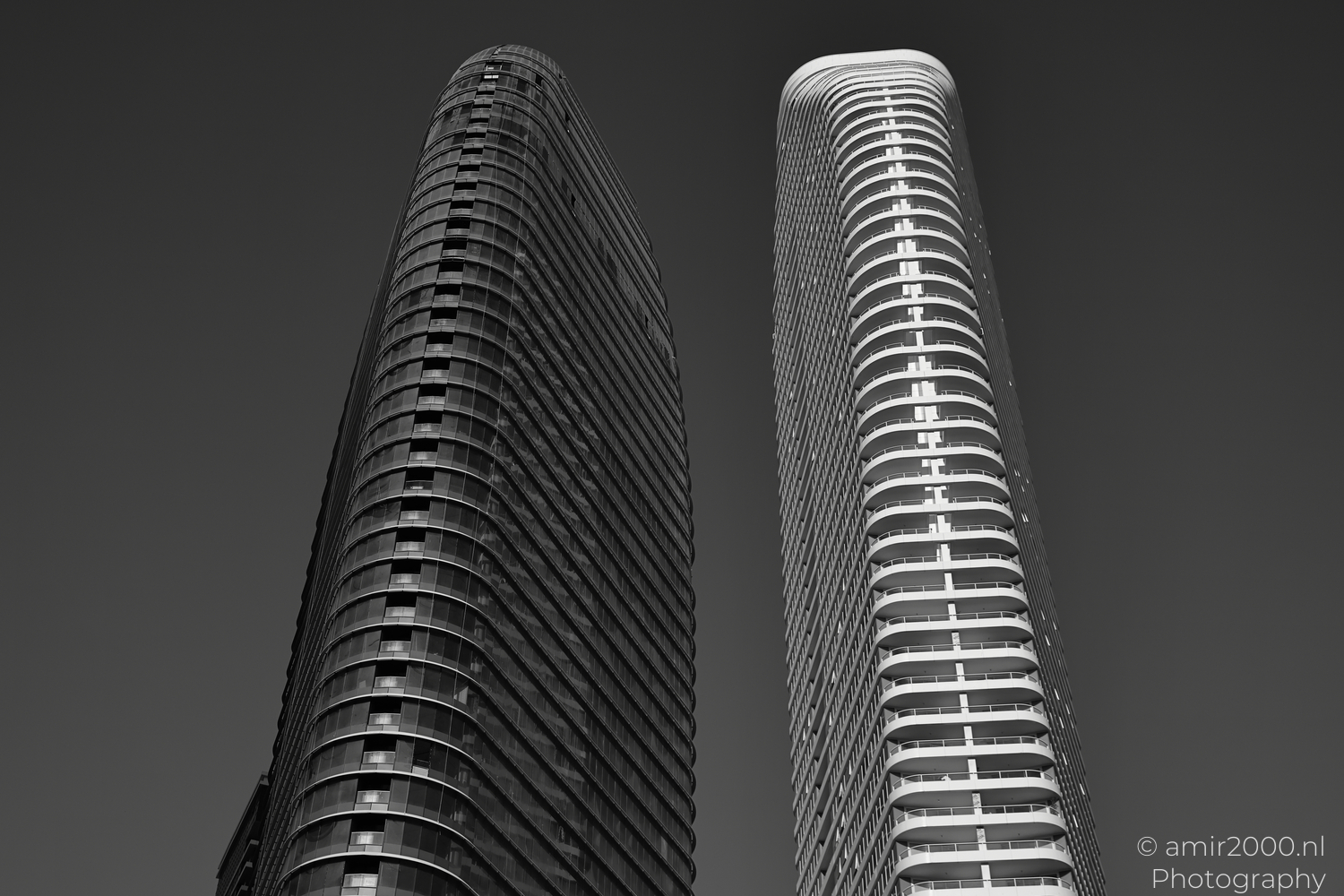
A dark sky presses against two curved towers, and the balconies start to look less like floors than ribs. The Exchange Ramat Gan skyscrapers feel almost detached from the city below them, as if the lower streets have been removed and only the vertical idea was left behind. Glass, concrete, and shadow do most of the work. The white tower catches the light like a stacked shell. The darker tower holds it back through a denser skin of windows and rounded edges. Ramat Gan is there, but at this point it feels more like a name attached to a fantasy version of the skyline than a place with traffic, corners, and pavement.
Exposure: 1/2000 sec | ISO: 125 | Aperture: f/5.0 | Focal Length: 28 mm | © amir2000.nl
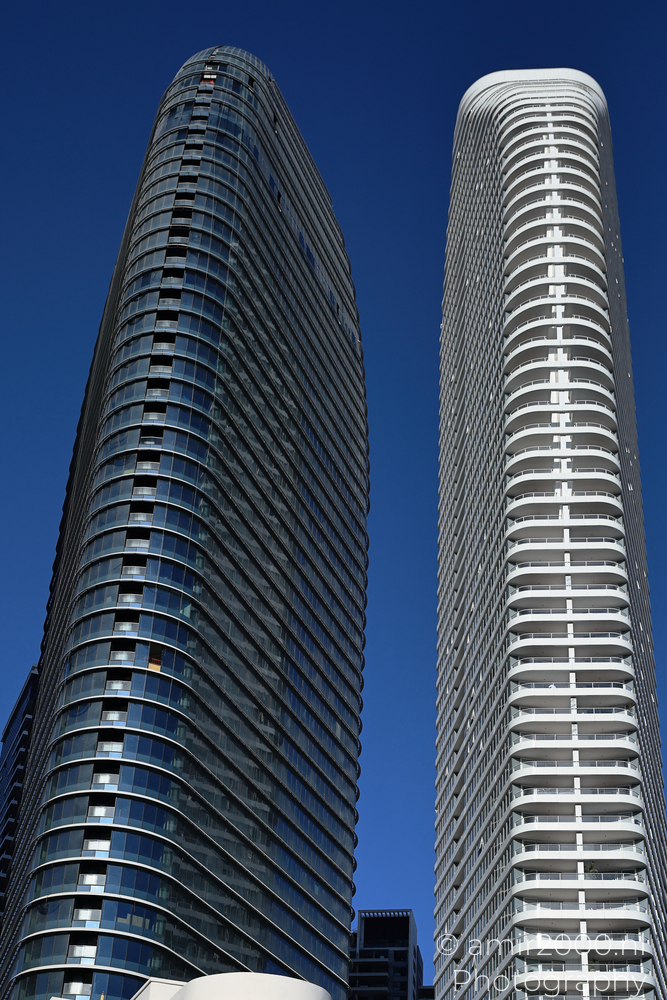
Under blue sky, the buildings stop floating and start showing their construction. One facade works through dark glass and repeated window bands, each floor bending around the curve with a tight rhythm. The other depends on stacked white balcony slabs, one level after another, until the rounded corners become the main language of the tower. Their contrast is simple but strong: one surface absorbs light, the other throws it back. Height is still the first thing you notice, but the materials begin to explain how that height is built.
Exposure: 1/2000 sec | ISO: 125 | Aperture: f/3.5 | Focal Length: 50 mm | © amir2000.nl
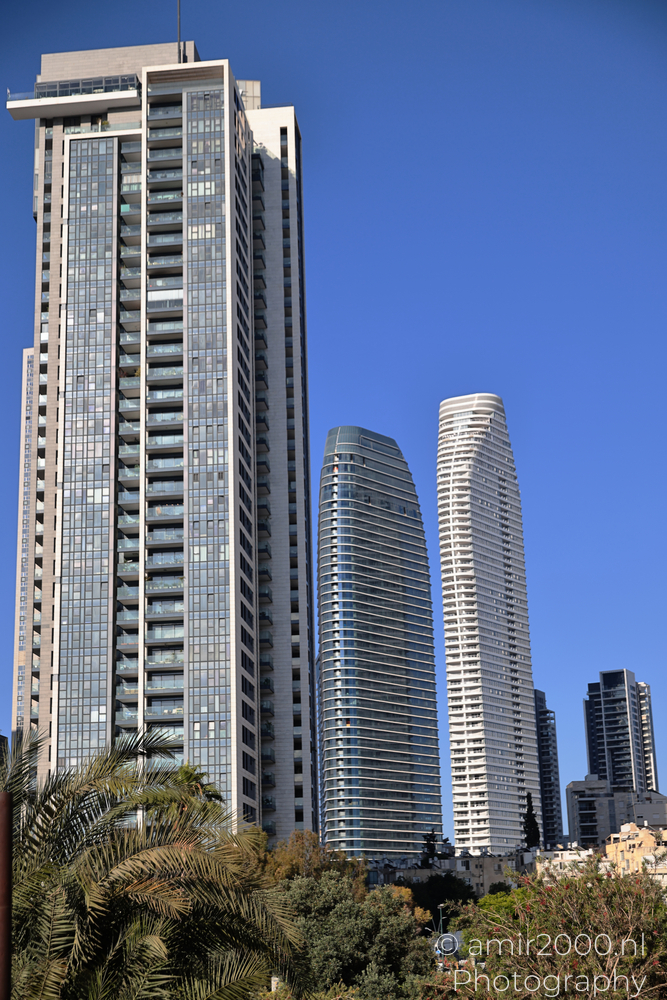
More of the district pulls the pair into ordinary scale. Another high-rise stands at the side, palms cut into the lower edge, and the space between the buildings becomes more important than the towers alone. The skyline no longer behaves like a private duel between two vertical forms. Older blocks, planted edges, and compressed gaps start to answer back. The dream has acquired neighbors, which is exactly when it becomes more convincing.
Exposure: 1/2000 sec | ISO: 125 | Aperture: f/3.5 | Focal Length: 24 mm | © amir2000.nl
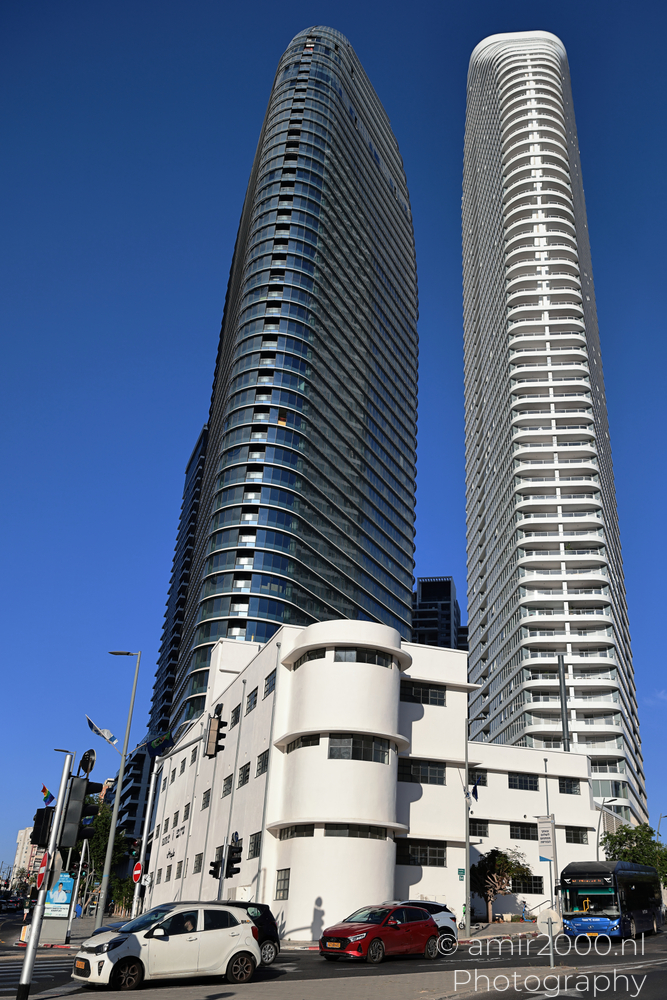
At street level, the myth has to deal with traffic. Cars sit under the towers, traffic lights cut across the clean vertical pull, and the lower white building with rounded corners becomes a hinge between the pavement and the skyscrapers above it. This is the useful friction in the scene. The towers were built to dominate from a distance, but the street gives them a job: to meet corners, signs, buses, parked cars, and people moving through the base of the district.
The strongest detail is not only the height, but the way the height finally lands. Curved balcony slabs continue upward, the dark glass grid keeps its strict repetition, and the rounded white corner at the base catches the whole structure before it escapes into skyline again.
More work from this gallery: Architecture gallery. More posts in this category: Architecture Photography.
Amir
Photographer, Builder, Dreamer
amir2000.nl
Comments
No comments yet. Be the first to comment!