
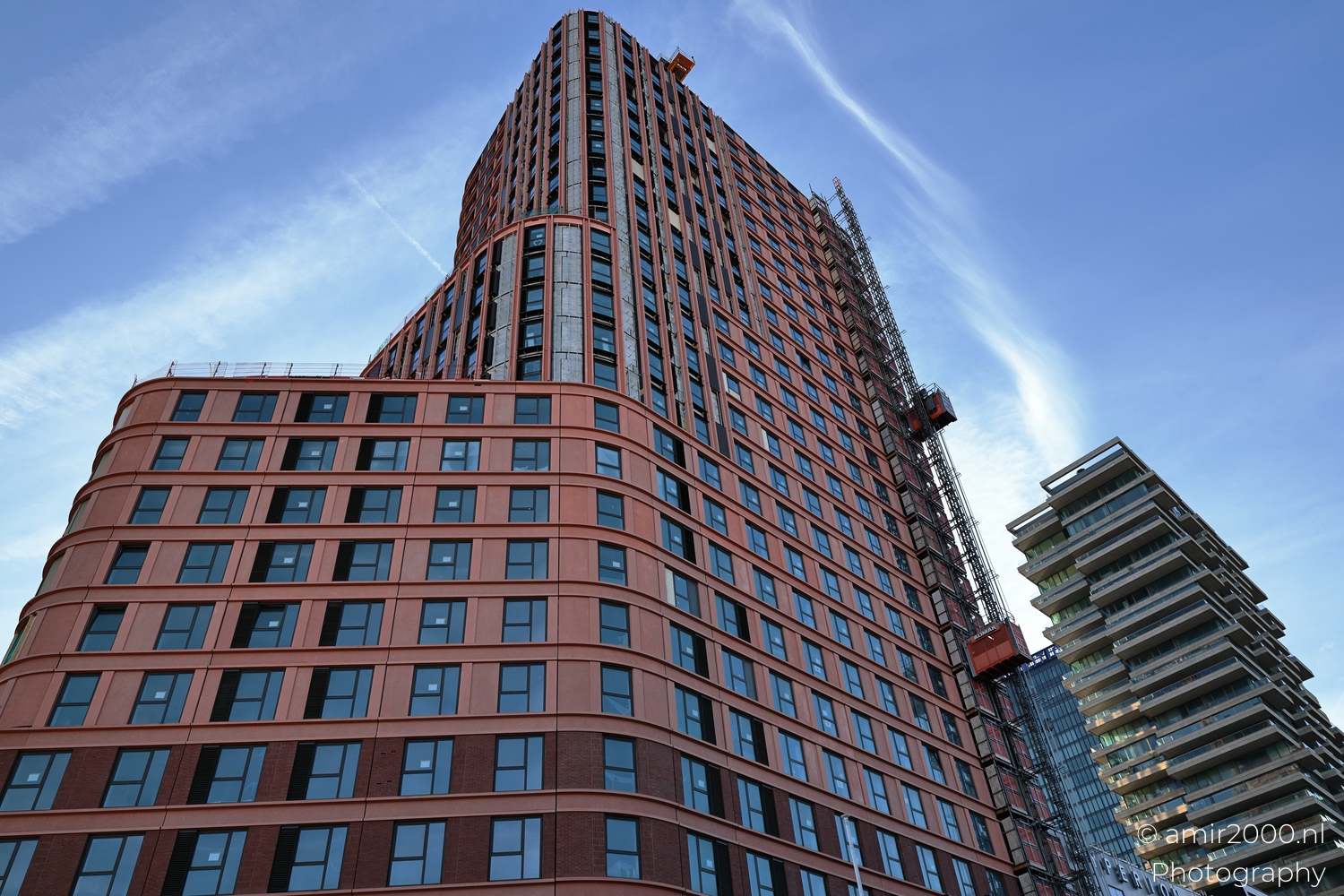
Modern architecture in Amsterdam rarely asks to be photographed quietly. Around Badhuiskade and Overhoeks, the buildings push upward, bend around corners, and repeat window grids until the whole street starts to feel like a study in rhythm. This set belongs in my Architecture Photography work because the shapes do more than fill the frame. They create movement, tension, and a clear sense of urban ambition. Even before looking at details, the skyline here signals that this is a district still defining itself through new form, scale, and residential density.
I stopped here because the winter light was right. It was bright enough to separate edges and surfaces, but still soft enough to keep the facades readable. What held my attention most was not just the height of the towers, but the way their facades repeat, curve, and shift. From street level, those choices become much more than design language. They become the subject. Instead of chasing a postcard view, I leaned into a low angle that lets the buildings dominate the frame and keeps the viewer inside the architecture rather than outside it.
That street level perspective matters. It exaggerates height, but it also reveals where a building either holds together or falls apart visually. If the rhythm is weak, the frame quickly becomes cluttered. If the design is confident, repetition starts to build momentum. In this set, the facades carry that weight well. Window spacing, balcony depth, corner curves, and shadow lines all do real work, which made this part of Amsterdam especially rewarding to photograph.
Street Level and Urban Scale
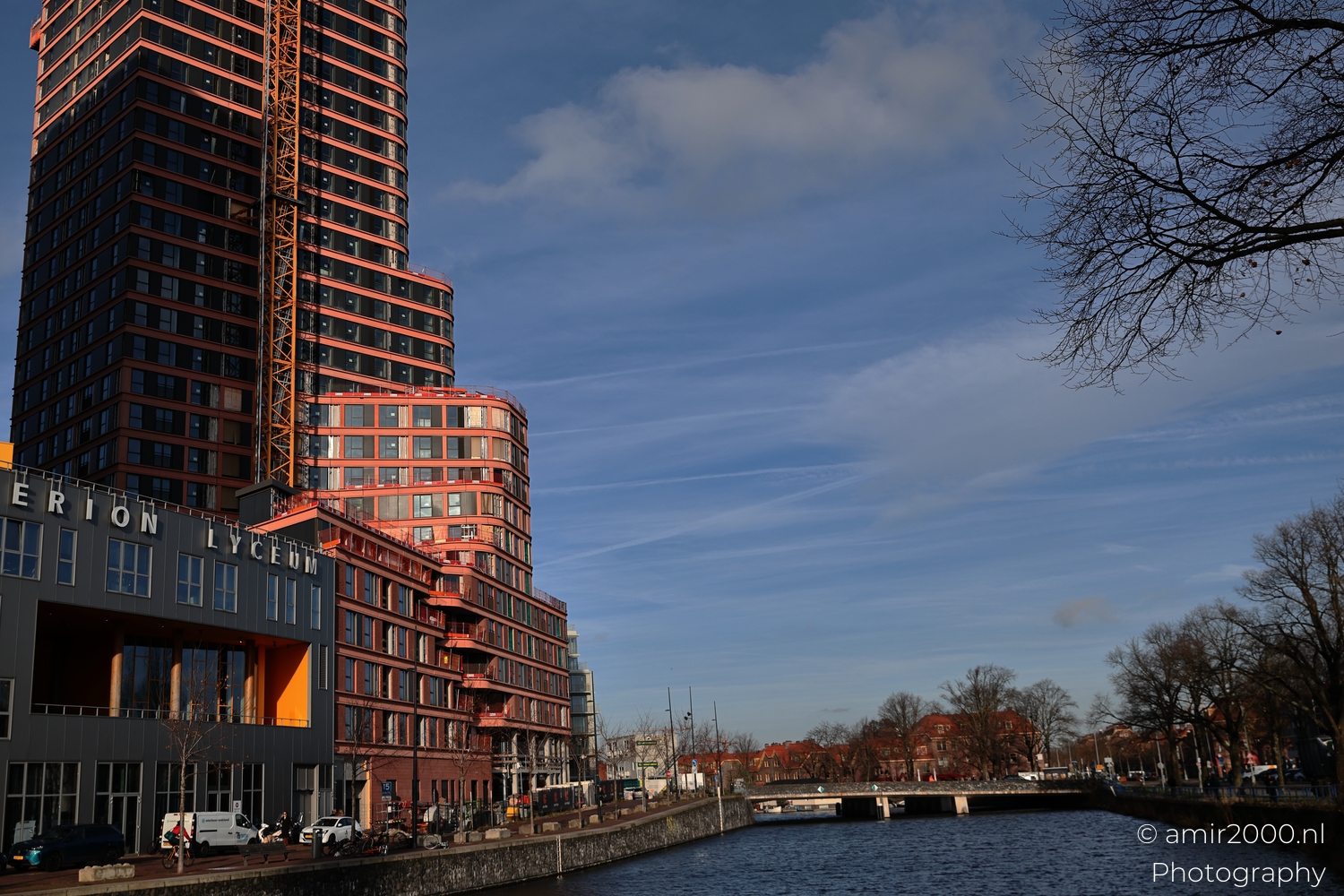
Exposure: 1/800 sec | ISO: 125 | Aperture: f/5.6 | Focal Length: 33 mm | © amir2000.nl
This wider view gives the architecture room to breathe. The main tower rises with a strong vertical pull, while the surrounding buildings help explain the density of the area instead of isolating the subject into a single abstract shape. The result feels urban rather than sculptural alone. That matters here, because these photographs are not only about one facade, but about how contemporary residential architecture claims space in a growing district. The image also works as a reminder that scale becomes easier to understand when neighboring volumes stay in the frame.
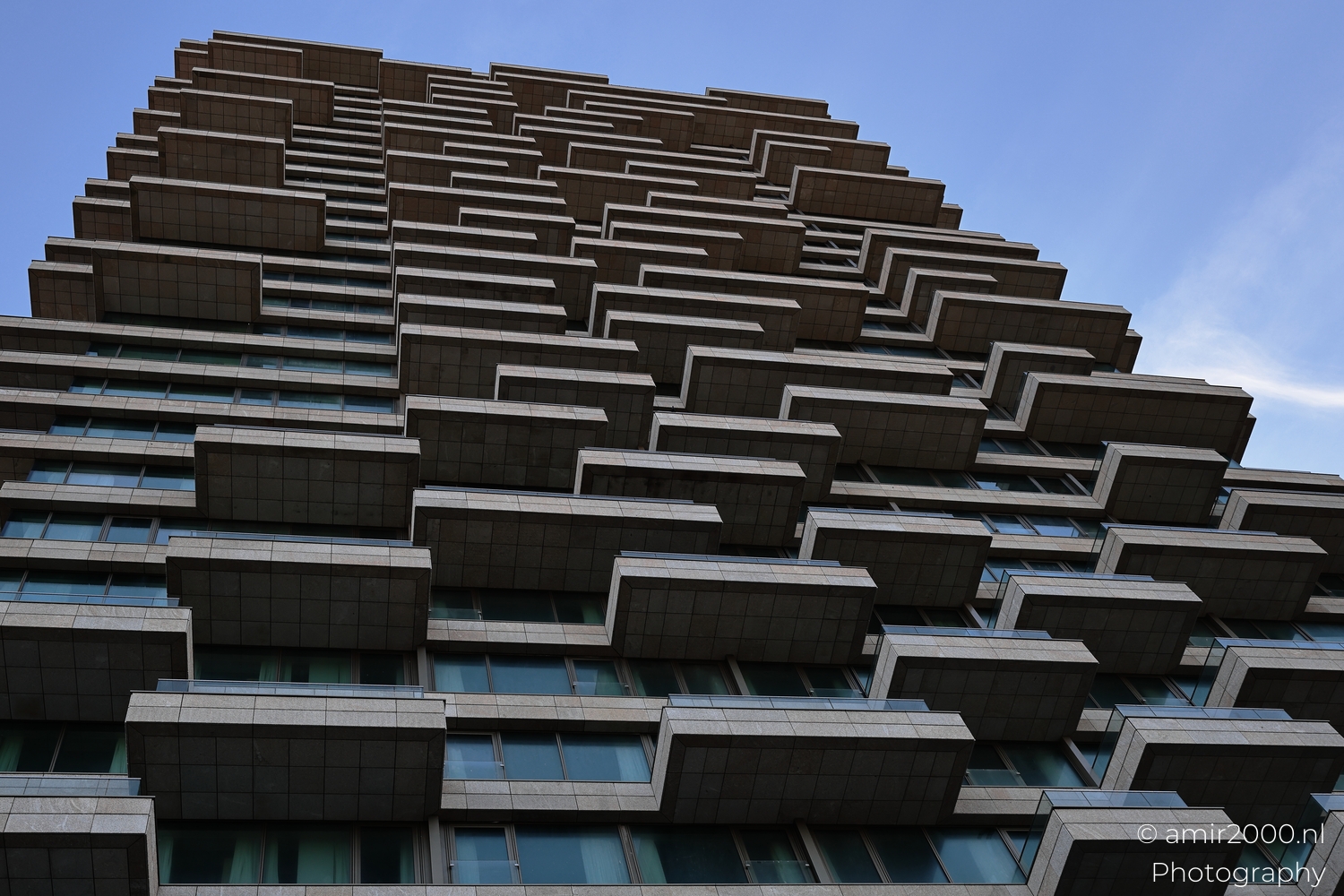
Exposure: 1/100 sec | ISO: 125 | Aperture: f/7.1 | Focal Length: 24 mm | © amir2000.nl
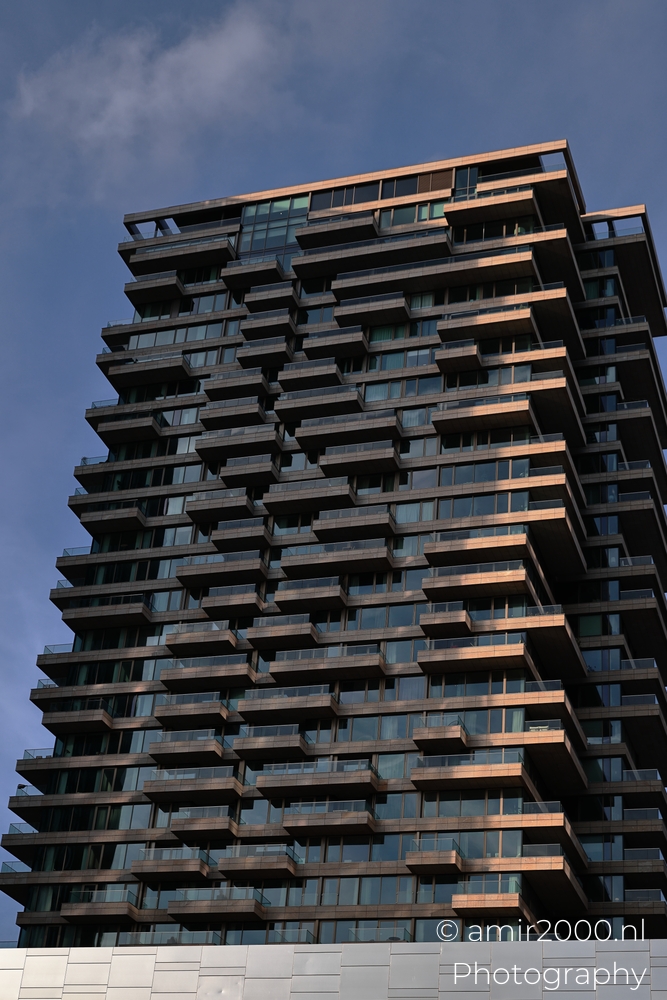
The Yvie facade changes the pace completely. Instead of a smooth tower face, it uses stacked balconies and projecting lines to create a more restless rhythm. Seen from below, the repetition is precise but never static. According to the project site, Yvie is part of Overhoeks and its residential tower offers 176 rental apartments, which adds useful context to the scale visible in the frame. What interests me most here is how the architecture avoids becoming mechanical. The balcony pattern repeats, yet each layer catches light differently enough to keep the surface active.
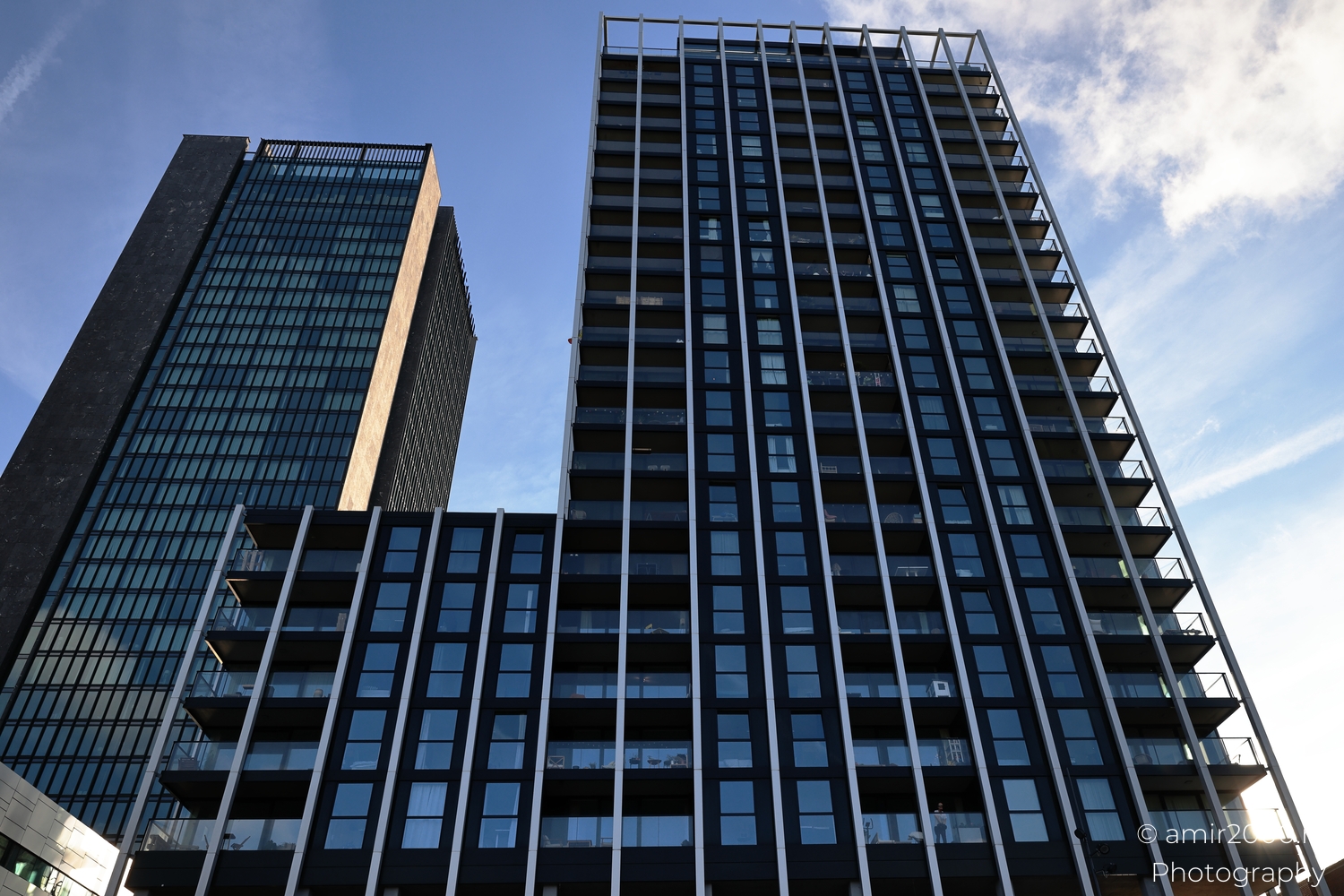
Exposure: 1/125 sec | ISO: 125 | Aperture: f/10 | Focal Length: 24 mm | © amir2000.nl
This angle strips the scene down to structure, repetition, and upward pressure. The dark window openings work like punctuation across the warmer facade, and the slight curve keeps the composition from turning too rigid. I like how the geometry becomes more insistent the longer you look. The building feels controlled, but not cold. It has enough variation in line and surface to stay alive inside the frame. The pale winter sky helps too, because it separates the tower clearly without stealing attention from the facade itself.
Facade Rhythm and Repetition
Exposure: 1/500 sec | ISO: 125 | Aperture: f/5.6 | Focal Length: 53 mm | © amir2000.nl
At this tighter distance, the photograph becomes almost entirely about cadence. Balcony after balcony steps outward, catches light, and throws a slightly different shadow. That small variation is what keeps a repeating facade interesting. It is also what makes architecture photography satisfying when the design is strong. You are not waiting for a person or a dramatic event. The building already contains enough visual tension on its own. A frame like this depends on discipline from the architect first and from the photographer second.
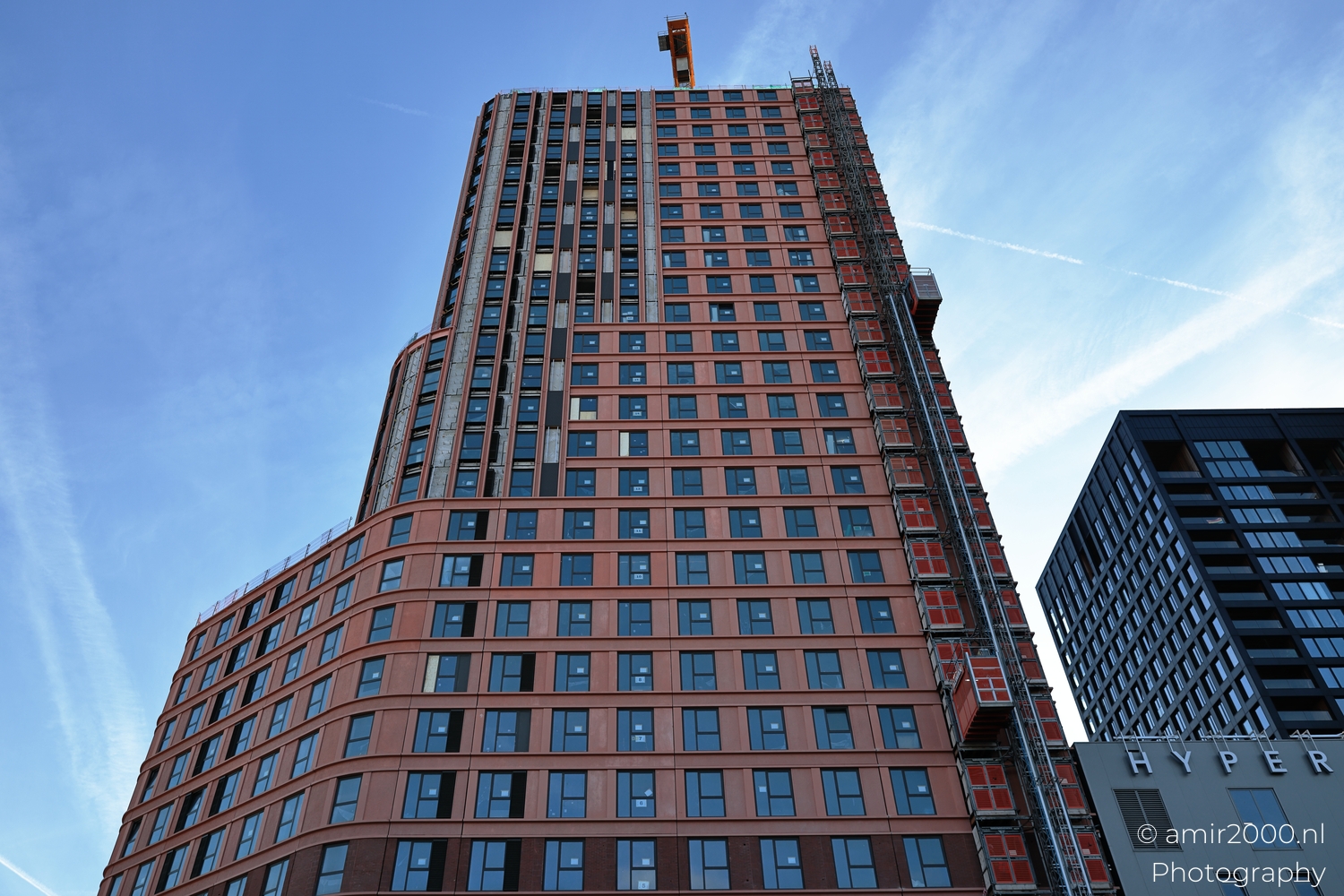
Exposure: 1/125 sec | ISO: 125 | Aperture: f/7.1 | Focal Length: 24 mm | © amir2000.nl
One detail I did not want to hide is the construction equipment still visible along part of the tower. It makes the image more honest. New districts do not arrive as finished postcards. They emerge in phases, with clean geometry on one side and practical reality on the other. In Overhoeks, that feels especially relevant, because the City of Amsterdam describes the area as a modern neighborhood in development on the former Shell site on the north bank of the IJ. The lift and scaffolding may interrupt the purity of the facade, but they also place the photograph in a specific moment rather than an idealized one.
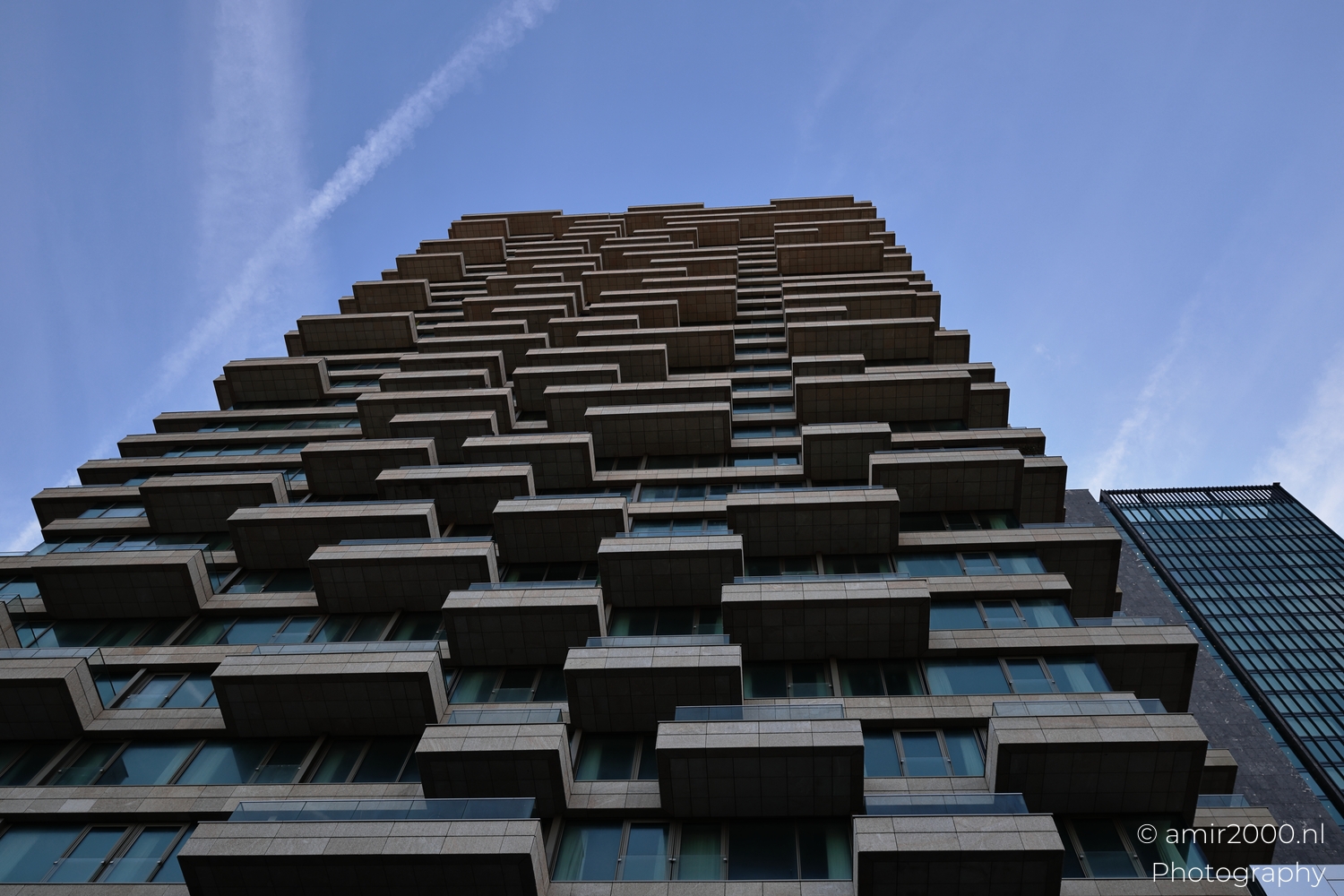
Exposure: 1/100 sec | ISO: 125 | Aperture: f/8.0 | Focal Length: 24 mm | © amir2000.nl
This final frame lands on what first pulled me in: facade rhythm and architectural uniqueness. The balconies stack in a way that feels measured, but never dull, and the recesses between them stop the mass from becoming flat. Even without a wide skyline view, the design holds attention because it keeps offering small differences within a disciplined system. More architecture work from this series can be found in the architecture gallery. It is the kind of facade that rewards patience, because the eye keeps finding another shift in depth, shadow, or alignment.
What I like most about this small series is how clearly it shows two different approaches to contemporary city building. One relies on smooth vertical rise and controlled curvature. The other uses projecting layers and repetition to make the facade itself do the talking. Both respond well to winter light, and both reward a street level viewpoint that keeps the camera looking up instead of trying to flatten the buildings into diagrams. For me, that is where architecture photography gets interesting: not in simple documentation, but in showing how design choices translate into rhythm, pressure, and presence once they meet real light and real city space.
Amir
Photographer, Builder, Dreamer
amir2000.nl
Comments
No comments yet. Be the first to comment!